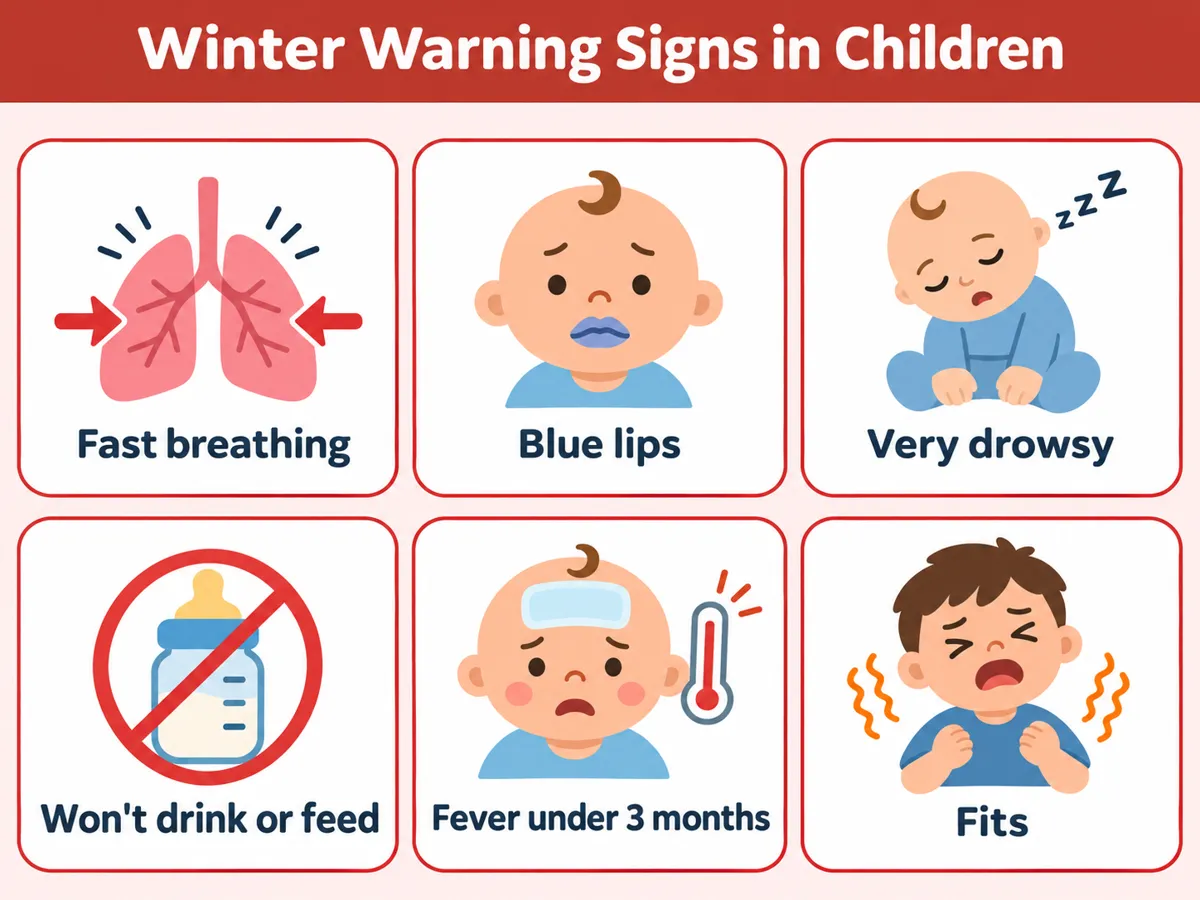
Quick answer: In winter, children spend more time indoors in closed, crowded rooms, so viruses spread easily from child to child. The most common winter illnesses in children are the common cold, flu, sore throat, ear infections, bronchiolitis in babies, pneumonia, asthma flare-ups and winter diarrhoea. Most are caused by viruses and get better with rest, fluids and care at home. Fast breathing, the chest sinking in, blue lips, a baby who won’t feed or a child who is very drowsy are signs to see a doctor straight away.
Key facts
- Most winter coughs, colds and fevers are caused by viruses. Antibiotics don’t work against viruses.
- Pneumonia is the single largest infectious cause of death in children worldwide (WHO), so it’s important to know its warning signs.
- Pakistan’s free EPI vaccines protect against several winter illnesses, including pneumonia (PCV, pentavalent), measles and rotavirus diarrhoea.
- A yearly flu vaccine is available for children from 6 months of age. Ask your doctor.
- Never leave a gas heater or coal fire burning in a closed room while your family sleeps.
Why do children get sick more in winter?
- More time indoors: children sit close together at home, school and in vans, so germs spread quickly.
- Closed windows: rooms are kept shut to stay warm, so germs stay in the air for longer.
- Smoke and smog: gas heaters, coal or wood fires (angeethi), cigarettes and winter smog irritate the airways and make chest infections more likely.
- Young immune systems: babies and toddlers are meeting many viruses for the first time.
Cold weather on its own doesn’t cause a cold. Germs do. But winter gives germs more chances to spread.
Winter illnesses at a glance
| Illness | Main signs | See a doctor if |
|---|---|---|
| Common cold | Runny or blocked nose, sneezing, mild cough, mild fever | Fever lasts more than 3 days, ear pain, or breathing gets fast |
| Flu | Sudden high fever, body aches, tiredness, cough | Breathing difficulty, very drowsy, or not drinking |
| Sore throat | Painful swallowing, red throat, fever | Can’t swallow saliva, drooling, or a muffled voice |
| Ear infection | Ear pain, pulling the ear, crying at night | Under 6 months, fluid from the ear, or swelling behind the ear |
| Bronchiolitis (babies) | Cough, wheeze, fast breathing, poor feeding | Feeding less than half the usual amount, or the chest sinking in |
| Pneumonia | Fast breathing, fever, cough, chest sinking in | Straight away, especially in babies under 2 months |
| Asthma flare-up | Wheeze, cough at night, tight chest | Reliever isn’t helping, or can’t speak in full sentences |
| Winter diarrhoea | Watery stools, vomiting | Signs of dehydration: few wet nappies, sunken eyes, very sleepy |
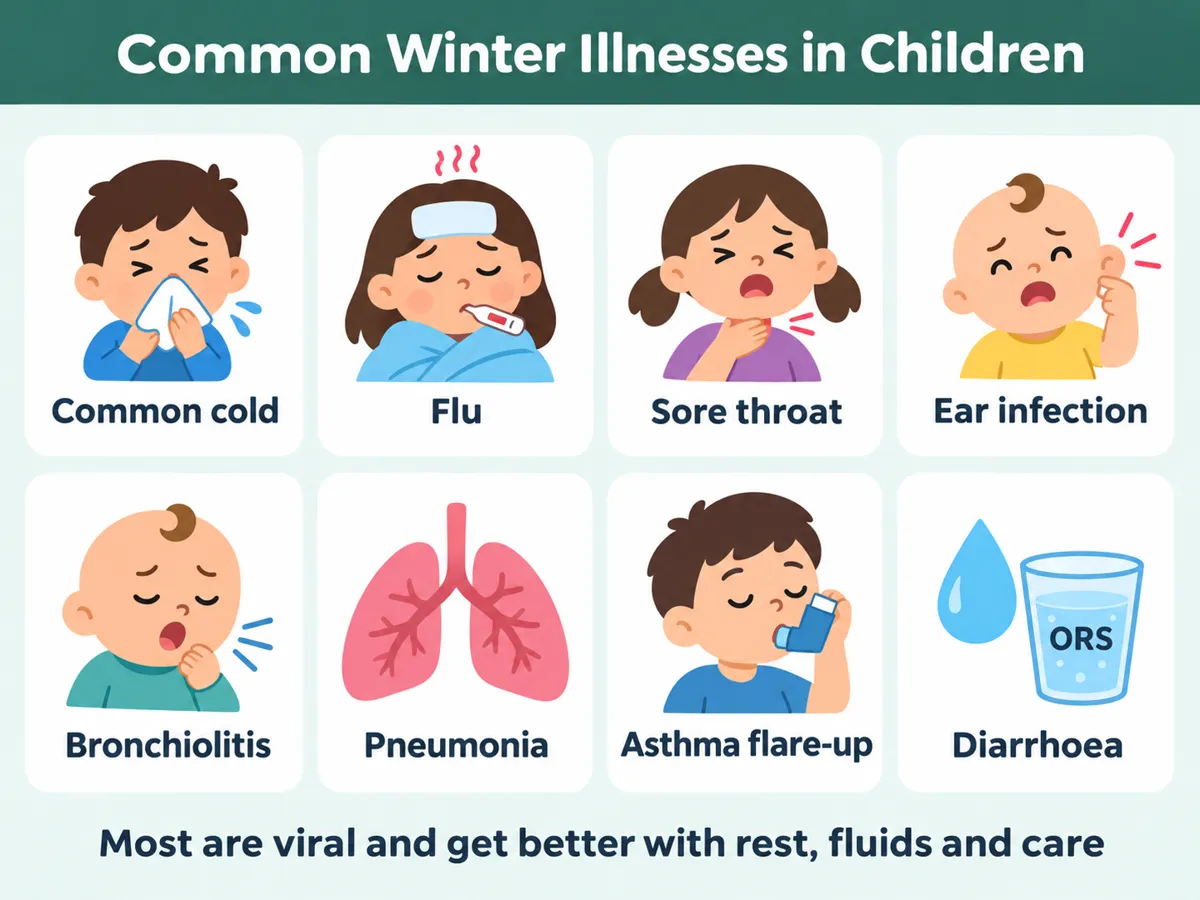
1. Common cold
The common cold is a viral infection of the nose and throat. It is the most common winter illness in children, and young children can catch several colds every winter.
Signs: runny or blocked nose, sneezing, mild cough, sore throat and a mild fever. The nasal discharge often turns thick and yellow or green after a few days. This is normal and doesn’t mean your child needs antibiotics.
Home care: rest, plenty of fluids and keep feeding. For a blocked nose in babies, keep the head slightly raised and gently clean the nose. Give only the fever medicine your doctor advises.
In young children, a cold can block the small tube that links the nose to the middle ear, which can lead to an ear infection. If your child pulls at an ear, cries more when lying down or gets a fever after a cold, see a doctor.
2. Flu (influenza)
Flu is caused by the influenza virus. Unlike a cold, it usually starts suddenly, with a high fever, shivering, body aches, headache, tiredness, cough and sore throat. Young children may also have vomiting or diarrhoea.
Most children recover at home with rest and fluids. Children under 5, and children with asthma, heart disease or other long-term conditions, are more at risk of complications such as pneumonia. A yearly flu vaccine helps protect them. Read more about viral fever in children.
3. Sore throat and strep throat
Most sore throats in winter are caused by viruses and settle on their own. Some are caused by bacteria (strep throat), which is more common in school-age children and may need treatment. Only a doctor can tell the difference after examining your child. Read our guide to throat infection in children.
4. Ear infections
Ear infections often follow a cold. Babies may pull at the ear, cry more at night or refuse feeds. Never put oil, garlic or anything else in a child’s ear. See our guide to ear infection in children.
5. Bronchiolitis in babies (RSV)
Bronchiolitis is an infection of the small airways in the lungs, usually caused by a virus called RSV. It mainly affects babies under 2 years, and it is most common in winter. It starts like a cold, then a cough, wheeze and fast breathing develop. The main danger is poor feeding and difficulty breathing, especially in babies under 3 months and babies born early.
6. Pneumonia
Pneumonia is an infection of the lungs. It often starts as a cold that gets worse instead of better. The most important sign is fast breathing. Count your child’s breaths for one full minute while they’re calm. Also watch for the lower chest sinking in with each breath. Read our full guide to pneumonia in children.
7. Asthma flare-ups
Cold air, colds, smoke and smog are common triggers for asthma in winter. Watch for wheeze, a cough at night and a tight chest. Keep your child’s inhalers as advised by your doctor, and keep them away from smoke. See asthma in children.
8. Winter diarrhoea and vomiting
Viruses such as rotavirus and norovirus spread easily in winter, causing watery diarrhoea and vomiting. The main risk is dehydration. Keep offering breast milk or fluids and ORS in small sips. Read diarrhoea and dehydration in children to learn the warning signs.
Caring for a sick child at home
- Fluids first: offer breast milk, water, soup or ORS often, in small amounts.
- Rest: let your child sleep and play quietly.
- Fever: dress your child in light layers. Don’t wrap a feverish child in thick blankets. Give only the fever medicine your doctor advises, in the right dose for their weight.
- No antibiotics without a doctor: most winter illnesses are viral, and leftover or shop-bought antibiotics can do harm.
- Avoid cough syrups for young children. They don’t treat the cause.
- Keep the room warm but airy: open a window a little for fresh air.
Keep your home safe this winter
- Never sleep with a gas heater, coal fire or angeethi burning in a closed room. These give off carbon monoxide, a poisonous gas you can’t see or smell.
- Keep heaters away from beds, curtains and children’s reach.
- No smoking or hookah indoors. Smoke makes chest infections and asthma worse.
- On heavy smog days, keep young children indoors when possible.
How to prevent winter illnesses
Vaccines that protect children in winter
- PCV and pentavalent vaccines (6, 10 and 14 weeks): protect against the main bacterial causes of pneumonia
- Rotavirus vaccine (6 and 10 weeks): protects against severe diarrhoea
- Measles-rubella vaccine (9 and 15 months)
- Yearly flu vaccine (from 6 months): ask your doctor, especially if your child has asthma or a heart condition
- Wash hands with soap, especially before eating and after coughing or sneezing
- Cover coughs and sneezes with a tissue or elbow
- Breastfeed babies. Breast milk helps protect against infections.
- Healthy food: fruit, vegetables and enough sleep keep children strong
- Keep sick children at home from school until the fever has gone
- Keep newborns away from people with coughs and colds
- Dress in layers: several thin layers keep children warmer than one thick one
Common winter myths
| Myth | Fact |
|---|---|
| “Ice cream or cold drinks cause a cold.” | Colds are caused by viruses, not cold food. |
| “A bath in winter causes pneumonia.” | A quick warm bath, followed by drying well, is safe and keeps children clean. |
| “Every cold needs an antibiotic.” | Most winter illnesses are viral. Antibiotics don’t help and can cause harm. |
| “Wrap a baby in many layers with the heater on all night.” | Overheating is unsafe for babies, and closed rooms with heaters can be dangerous. Dress babies in comfortable layers. |
| “Green mucus means a bacterial infection.” | Thick, coloured mucus is common in viral colds. |
When to see a doctor
Come to the KCIH Emergency now (open 24/7: 051-4850480) if your child:
- Is breathing fast, or the lower chest sinks in with each breath
- Has blue or grey lips
- Is very drowsy, floppy or hard to wake
- Won’t drink or feed, or has signs of dehydration
- Is a baby under 3 months with a fever of 38°C or higher
- Has a fit (convulsion)
- Has a headache with a stiff neck, or a rash that doesn’t fade when pressed
See a child specialist the same week if a fever lasts more than 3 days, a cough lasts more than 3 weeks, your child has ear pain, or you’re worried.
Our child specialists, including Dr. Samer Sikander in the Pediatric Medicine department, see children with winter illnesses every day. Our children’s emergency is open 24/7 on Saidpur Road, Rawalpindi, about 20 minutes from Islamabad. Call 051-4850480 or 0339-4850480.
For more ways to protect your child this season, read our winter health tips for children.
Frequently asked questions
What are the most common winter illnesses in children?
The common cold, flu, sore throat, ear infections, bronchiolitis in babies, pneumonia, asthma flare-ups and viral diarrhoea.
How can I tell if my child’s cold is something more serious?
Watch the breathing. Fast breathing, the chest sinking in, a fever that lasts more than 3 days, ear pain or a child who stops drinking are reasons to see a doctor.
Can I send my child to school with a cold?
Yes, if there’s no fever and your child feels well enough. Keep them at home while they have a fever.
Should my child get the flu vaccine?
The flu vaccine can be given every year from 6 months of age. It’s especially useful for children under 5 and those with asthma or heart disease. Ask your child’s doctor.
Sardiyon mein bachon ko nazla zukam ho to kya karein?
Bachay ko aaram karwain, pani aur doodh zyada dein, aur doctor ki batai hui bukhar ki dawai hi dein. Agar saans tez ho, pasliyan andar dhans rahi hon, bacha doodh na pee raha ho ya bohat sust ho, to foran doctor ko dikhayein.
This guide is for information and does not replace a doctor’s examination.
Experts You Can Trust
Learn more about our Child Health Conditions A–Z and our editorial process.