- info@kcih.pk
- 051-4850480 | 0339-4850480
Most parents come to us with the same sentence: “The cough just will not go.” Weeks of syrups, two or three courses of antibiotics, a cough worse at night that settles by mid-morning, and a child who runs out of breath before the others do. Very often that is not a stubborn chest infection. It is asthma — what families here call damma.
Asthma is common, and it is manageable. A child with well-controlled asthma sleeps through the night, attends school, plays cricket and grows normally. The difficulty in Pakistan is that a great many children are not well controlled. A 2024 study of asthmatic children in Karachi found more than a third had uncontrolled asthma, and parents’ understanding of the condition was often inadequate — not through any fault of theirs, but because nobody had explained it properly.
Our air makes this harder. UNICEF has warned that over 11 million children under five were exposed to smog in the worst-affected districts of Punjab, and pediatric wards see a clear surge in wheezing every smog season. This guide from the Pediatric Medicine team at Kids Care International Hospital explains what asthma is, the symptoms parents most often miss, the triggers that matter in Pakistani homes, and how treatment really works.
Air reaches the lungs through tubes called airways. In a child with asthma, those airways are permanently sensitive. When something irritates them — smoke, dust, a cold virus, cold air — three things happen at once: the lining swells, the muscles around the tube tighten, and sticky mucus collects inside.
The tube narrows and breathing out becomes hard work — like breathing through a straw someone is slowly pinching. That is where the whistling comes from, and why the chest feels tight.
Two points follow from this, and they explain almost everything about treatment. First, the swelling is present even when your child seems perfectly fine — which is why the daily medicine matters. Second, asthma is not an infection and is not contagious. No child catches asthma from another child, and no antibiotic treats it.
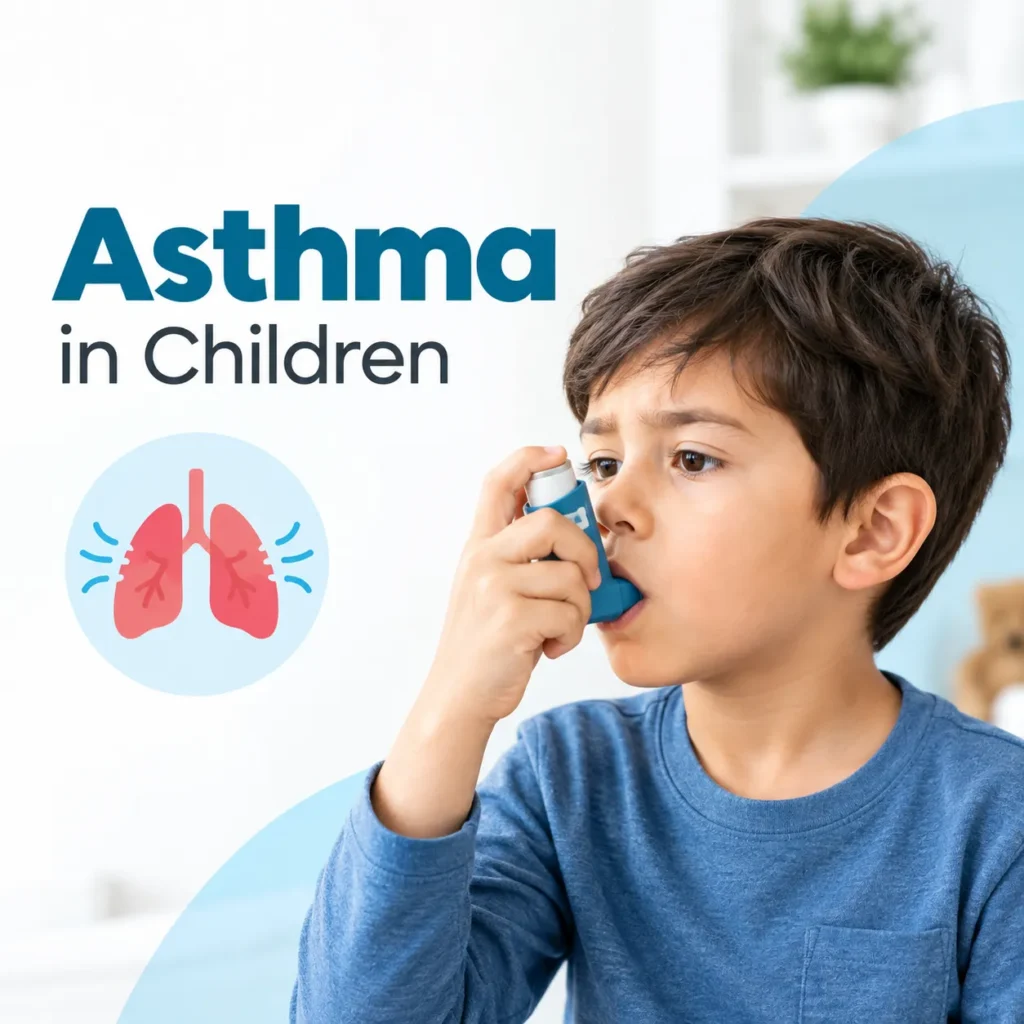
The classic picture is wheezing and breathlessness. But many children never wheeze loudly, and their asthma goes unrecognised for months. Watch for these patterns instead:
• A cough that keeps coming back, especially a dry cough at night or in the early hours. Cough may be the only symptom a child ever has.
• Coughing or breathlessness during play, running, laughing or crying — and a child who stops to rest while friends keep going.
• A whistling sound on breathing out, often heard best when the room is quiet at night.
• “My chest feels heavy” or “my chest hurts.” Younger children rarely say “tight” — they say it hurts, or point to it.
• Every cold going to the chest, taking weeks to clear, or repeatedly being called bronchitis or pneumonia.
• Tiredness and poor concentration at school, usually because night coughing is breaking the child’s sleep.
• In babies and toddlers, feeding slowly, tiring during feeds, or fast breathing.
Symptoms that are worse at night, worse with exercise, worse in dusty or smoky air, and better after a bronchodilator are the pattern that points strongly to asthma.
Every child has their own set of triggers. Identifying your child’s few is more useful than avoiding everything.
| Trigger | Why it matters here | What actually helps |
|---|---|---|
| Smog and air pollution | Peaks across Punjab and the twin cities in the cooler months, and pediatric wheezing rises with it. | Check air quality before outdoor play; windows shut on bad days; never stop the controller in this season. |
| Tobacco smoke | One of the strongest risk factors — including smoking on the balcony or in the car. | No smoking inside the home or vehicle. Smoke on clothing also triggers attacks. |
| Cooking and heating smoke | Wood, coal and biomass stoves, and unvented gas heaters in winter. | Ventilate the kitchen, keep the child out of it, and check heaters are vented. |
| Mosquito coils and incense | Widely used, genuinely potent airway irritants, and almost always overlooked. | Switch to plug-in repellents or a net in the child’s room. |
| Dust and dust mites | Construction dust, carpets, heavy curtains, soft toys, old bedding. | Wash bedding weekly in hot water; damp-dust instead of sweeping. |
| Colds and chest infections | The commonest trigger in young children. | Handwashing, flu vaccine if advised, and act early on the action plan. |
| Exercise, cold air, pollen, strong smells | Running and cricket, winter mornings, spring pollen, perfumes and sprays. | Children should still play. A scarf over the nose on cold mornings helps; avoid spraying near the child. |
One trigger deserves special mention because it is so easily fixed: the mosquito coil burning in the child’s room all night. It is smoke, in an enclosed room, for eight hours, beside a sensitive airway. Removing it sometimes settles months of night cough on its own.
There is no single test in young children. Diagnosis rests mainly on the story — the pattern of symptoms, what brings them on, when they occur, whether they respond to a bronchodilator, and the family history. The doctor will also examine the chest, check growth, and look for allergic rhinitis or eczema, which often travel with asthma.
From about five or six years of age, a child can usually manage spirometry — a breathing test that measures how much air they can blow out and how fast, before and after a bronchodilator. Improvement after the medicine supports the diagnosis.
Under five, children cannot perform these tests reliably, so doctors often start a trial of treatment for a few weeks and watch: clear improvement on treatment, and symptoms returning when it stops, is itself strong evidence. A chest X-ray is used mainly to rule out other causes, not to confirm asthma.
There is no single test in young children. Diagnosis rests mainly on the story — the pattern of symptoms, what brings them on, when they occur, whether they respond to a bronchodilator, and the family history. The doctor will also examine the chest, check growth, and look for allergic rhinitis or eczema, which often travel with asthma.
From about five or six years of age, a child can usually manage spirometry — a breathing test that measures how much air they can blow out and how fast, before and after a bronchodilator. Improvement after the medicine supports the diagnosis.
Under five, children cannot perform these tests reliably, so doctors often start a trial of treatment for a few weeks and watch: clear improvement on treatment, and symptoms returning when it stops, is itself strong evidence. A chest X-ray is used mainly to rule out other causes, not to confirm asthma.
Nearly all confusion about asthma treatment comes from not knowing there are two different inhalers doing two different jobs.
The reliever — for symptoms now
Usually salbutamol, often a blue inhaler. It relaxes the tightened muscles around the airway and opens it within minutes. It is what you use during an attack or before sport if advised.
What it does not do is treat the underlying swelling. So a child needing the reliever often is not doing well — their asthma is out of control. Needing it more than about twice a week means going back to the doctor, not buying another inhaler.
The controller — for the underlying inflammation
Usually a low-dose inhaled steroid, taken every day whether or not the child feels unwell. It settles the swelling inside the airways so that triggers stop causing attacks in the first place. It works slowly, over weeks, and gives no immediate sensation of relief — which is exactly why families stop it, and exactly why they should not.
An important update: international guidelines no longer recommend treating asthma with a reliever inhaler alone at any stage, even mild asthma. Reliever-only treatment leaves the inflammation untreated and is linked to a higher risk of severe attacks. Some older articles still say a quick-relief inhaler is all that mild asthma needs. That advice is out of date, and your child’s doctor will explain which combination is right for their age.
The spacer — the part most families are never given
A spacer is a plastic chamber that the inhaler fits into. The child breathes from the chamber through a mouthpiece, or a mask for younger children.
This is not an optional accessory. Used directly, much of the medicine hits the back of the throat instead of the lungs, because pressing and inhaling at exactly the same moment is genuinely hard for a child. With a spacer far more of the dose reaches the airways, and throat irritation is less likely. Every child on an inhaler should have one; under about five they need a spacer with a mask.
Ask the doctor or nurse to watch your child use the inhaler and correct the technique. Poor technique is one of the most common reasons treatment appears to fail, and it takes two minutes to fix.
What about the nebulizer?
Nebulizers are widely believed to be stronger. For most attacks they are not. An inhaler used properly with a spacer delivers the medicine just as effectively, sets up faster, and works anywhere. Nebulizers still have a role in hospital and in severe attacks, but they are not a better everyday treatment.
The asthma action plan
Ask for a written plan. A good one fits on one page: the daily medicines, what to do when symptoms start, when to step treatment up, and the point at which you go straight to hospital. Keep a copy at home and give one to the school. In an emergency nobody thinks clearly — the plan does the thinking for you.
| What people commonly believe | What is actually true |
|---|---|
| Inhalers are addictive — once started the child can never stop. | They contain nothing habit-forming. What looks like dependence is simply asthma that is still there and still needs treating. |
| Inhalers are a last resort for severe cases. | They are the first and safest treatment. Inhaled medicine reaches the lungs in a tiny dose, so far less enters the body than with syrups or tablets. |
| Steroids in inhalers stunt growth. | Doses are very small and any effect on growth is minor and largely temporary. Poorly controlled asthma — broken sleep, repeated oral steroid courses — harms growth more. |
| Stop the inhaler once the child is well. | Feeling well means it is working. Stopping lets the swelling return within weeks. Only the doctor steps treatment down. |
| A nebulizer is stronger than an inhaler. | For most attacks an inhaler with a spacer works just as well and is far more practical. |
| Children with asthma should avoid sports. | They should play fully. Sitting out means the asthma needs better control, not that sport should stop. |
| Cold foods, rice, banana or curd cause asthma. | Food does not cause asthma, and needless restriction harms nutrition. True food allergy is separate and can be assessed. |
| Asthma is contagious. | It is not an infection and cannot spread between children. |
Well-controlled asthma should be almost invisible. Aim for a child who sleeps through without coughing, plays sport without stopping, misses no school, and rarely reaches for the reliever. Practical steps that make the biggest difference:
1. Give the controller daily at the same time, even in good weeks — attach it to brushing teeth.
2. Use a spacer every time, and have the technique checked at each visit.
3. Keep the home smoke-free — no cigarettes, and rethink mosquito coils and incense in the child’s room.
4. During smog season, check air quality before outdoor play, keep windows closed on the worst days, and do not stop or reduce the controller. This is the season it is needed most.
5. Send the action plan and a labelled reliever inhaler with spacer to school, and make sure a teacher knows how to use it.
6. Keep follow-up appointments even when your child is well — asthma changes as children grow, and treatment often needs adjusting up or down.
Around half of children improve considerably by adolescence. Even then the airways stay sensitive and symptoms can return in adult life, so improvement is a reason to review treatment with the doctor — not to declare the asthma finished and throw the inhaler away.
Book an appointment if your child has a cough lasting more than three to four weeks, coughs at night most weeks, wheezes, gets breathless during play, or has had repeated chest infections. Come sooner if they are already on an inhaler but still using the reliever more than twice a week, waking at night, or missing school.
The Pediatric Medicine department at Kids Care International Hospital, Rawalpindi, diagnoses and manages childhood asthma — assessment, breathing tests where age allows, a written action plan, inhaler and spacer training for parents, and 24-hour pediatric emergency care for acute attacks. As a dedicated children’s hospital, our equipment, spacer sizes and dosing are set up for small patients rather than adapted from adult practice.
You can view our child specialists and consultant child specialist Dr Samer Sikander and book online, or bring your child to the emergency department at any hour if they show the danger signs above.
About half of children improve considerably by their teenage years, and many have few or no symptoms as adults. But the airways stay sensitive, and symptoms can return later in life. Asthma is best thought of as controlled rather than cured — and controlled asthma allows a completely normal childhood.
No. Inhalers contain nothing habit-forming. Because the medicine is inhaled directly into the lungs, the dose is much smaller than a syrup or tablet and far less reaches the rest of the body. Untreated asthma carries the real risk, not the inhaler.
Inhaled steroid doses are very low, and any effect on growth is small and mostly temporary. By contrast, uncontrolled asthma — broken sleep, missed activity and repeated courses of oral steroids for attacks — affects growth more. Your doctor keeps the dose at the lowest level that maintains control and monitors growth at visits.
Yes. Cough can be the only symptom, particularly at night or with exercise. A dry cough that keeps returning for weeks, is worse at night, and does not respond to antibiotics should be assessed for asthma.
A spacer should be used every time. Without one, much of the dose lands in the mouth and throat instead of the lungs, because a child cannot easily press and breathe in at the same instant. Children under about five need a spacer with a mask.
Yes, and they should. Children with well-controlled asthma play cricket, run and take part in PE. If sport regularly brings on symptoms, the asthma needs better control — tell your doctor rather than withdrawing your child from activity.
Air pollution irritates already sensitive airways and reliably increases attacks and hospital visits during the smog months. Continue the controller inhaler throughout the season, check air quality before outdoor play, keep windows shut on the worst days, and contact your doctor early if symptoms increase rather than waiting.