- info@kcih.pk
- 051-4850480 | 0339-4850480
Quick answer: An ear infection is an infection of the middle ear, the small space behind the eardrum. It usually starts after a cold, when germs and fluid get trapped behind the eardrum and cause pain and fever. Most ear infections in children get better within 2 to 3 days, and many clear without antibiotics. A baby under 6 months with ear pain or fever, a swelling behind the ear, or pus or blood coming from the ear needs a doctor the same day.
The ear has three parts: the outer ear you can see, the middle ear behind the eardrum, and the inner ear, which sends sound to the brain. A thin tube, the eustachian tube, links the middle ear to the back of the nose. It lets air in and fluid drain out.
In children this tube is short, narrow and almost flat. During a cold it swells and blocks, fluid collects behind the eardrum, and germs grow in it. Doctors call this acute otitis media. Parents in Pakistan usually call it “kaan ka dard” or “kaan mein infection”.
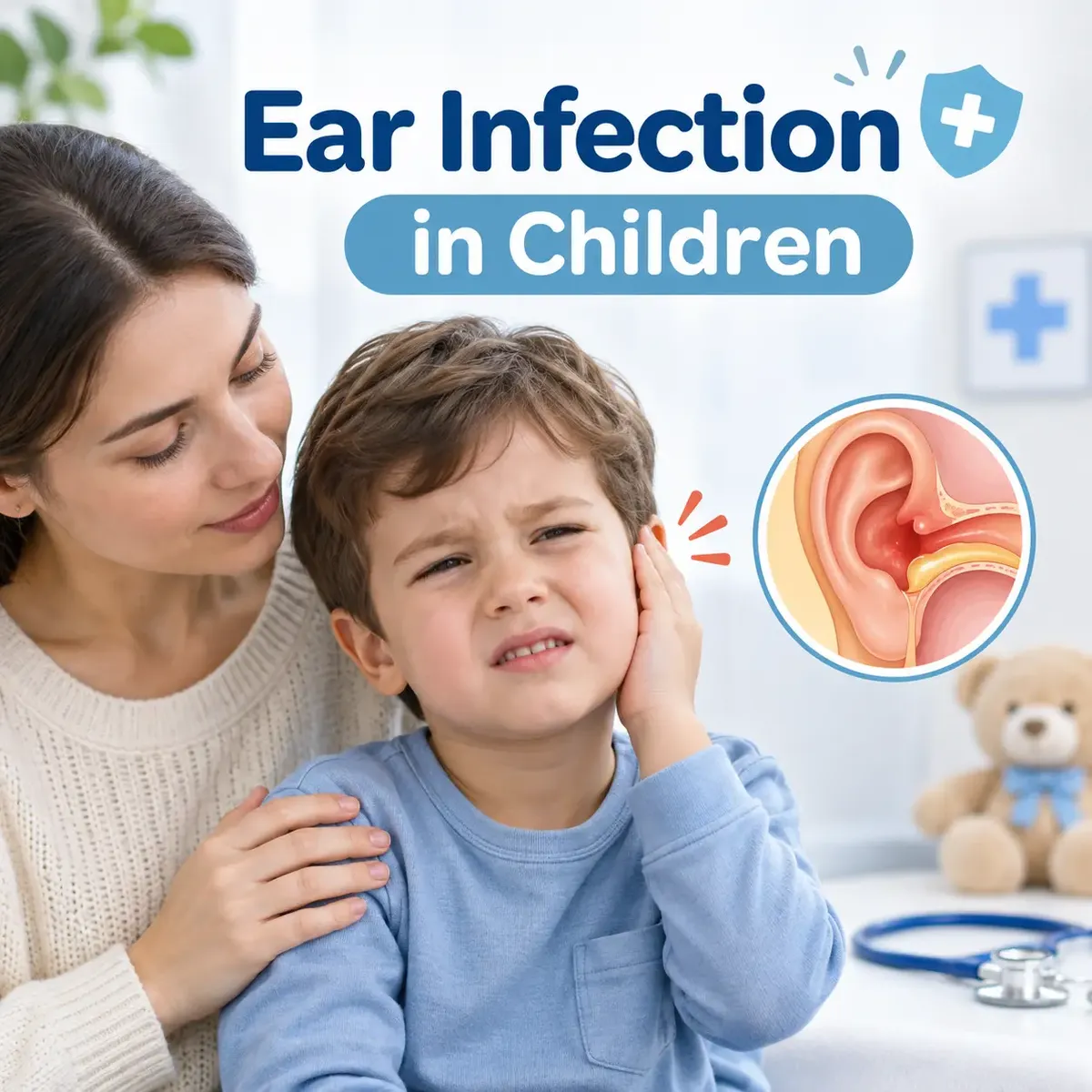
Doctors describe three main types:
| Type | What happens | What you may notice |
|---|---|---|
| Acute ear infection (acute otitis media) | Infected fluid behind a red, bulging eardrum | Sudden ear pain, fever, crying |
| Glue ear (otitis media with effusion) | Fluid stays behind the eardrum without infection | Often no pain; not hearing well, speech delay |
| Chronic discharging ear (chronic suppurative otitis media, “kaan behna”) | A hole in the eardrum with pus coming out for weeks | Smelly discharge, poor hearing, little pain |
Chronic discharging ears are still common in Pakistan, especially when early infections aren’t treated or ears are cleaned with oil and sticks. This type needs a doctor’s care, not home remedies, because it can permanently damage hearing.
Outer ear infection (“swimmer’s ear”) is different. It affects the ear canal, not the middle ear, and the ear hurts when the outer ear is pulled or pressed. It is more common in children who swim.
Older children can tell you: “my ear hurts”, “my ear feels blocked” or “I can’t hear properly”.
Babies and toddlers can’t, so watch for:
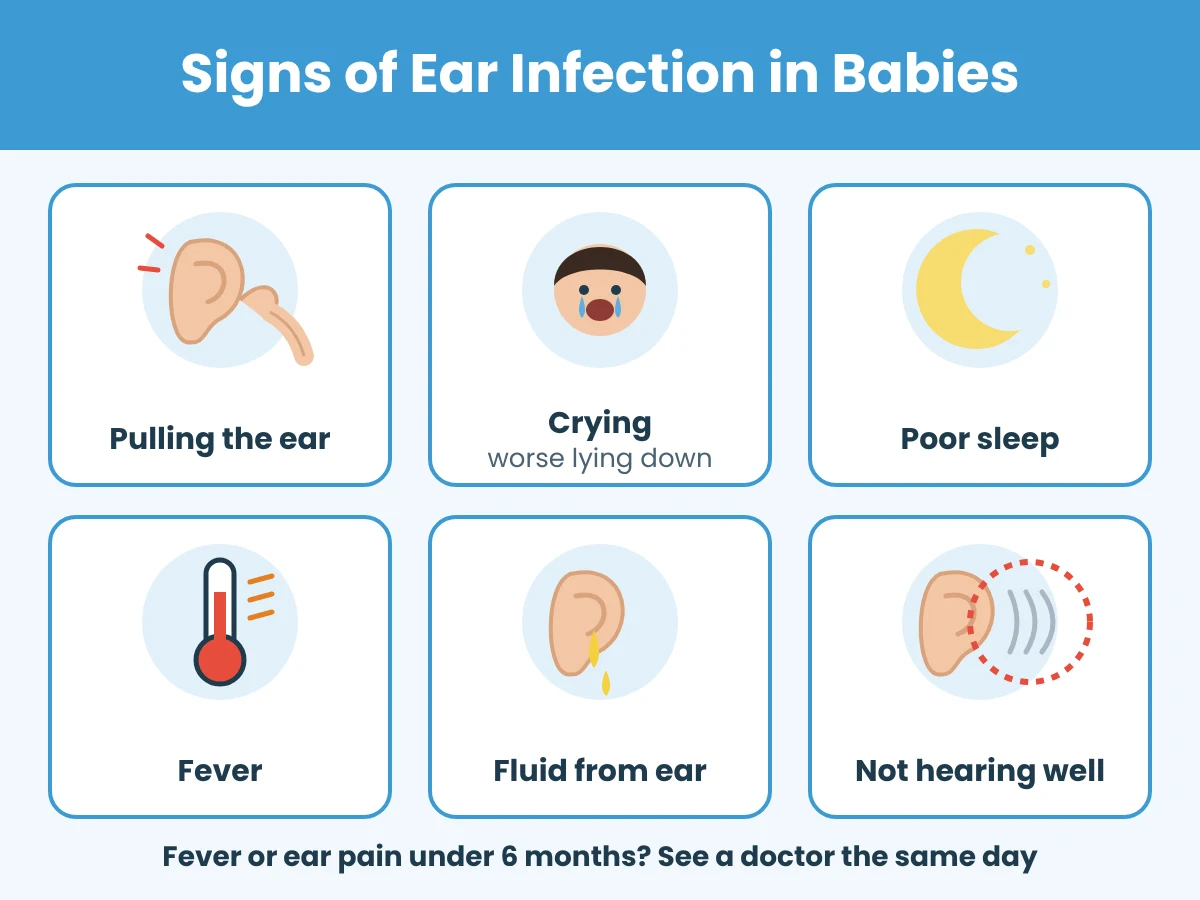
If pain suddenly eases and fluid appears, the eardrum may have burst. This sounds scary, but the small hole usually heals on its own within a few weeks. Your child should still see a doctor.
These can be signs of the infection spreading to the bone behind the ear (mastoiditis) or nearby, which needs urgent treatment.
See a doctor the same day or the next day if:
The doctor looks into the ear with a small light called an otoscope. A red, bulging eardrum with fluid behind it shows an infection. Sometimes the doctor uses a gentle puff of air to see how the eardrum moves, or a quick, painless pressure test (tympanometry). If fluid has stayed for a long time, a hearing test may be advised. Children of any age, even newborns, can have their hearing tested.
Many ear infections clear on their own because the body fights the germs. Doctors in many countries follow guidance from the American Academy of Pediatrics:
| Child’s age | What doctors usually do |
|---|---|
| Under 6 months | Treat with antibiotics, because complications are more likely in young babies |
| 6 months to 2 years | Antibiotics if the infection is severe or in both ears; otherwise the doctor may watch closely for 2–3 days |
| Over 2 years | Mild infections are often watched for 2–3 days with pain relief; antibiotics if not improving |
Pain relief comes first. Give only the pain or fever medicine your doctor advises, in the dose for your child’s weight. Don’t use ear drops unless a doctor has checked the ear, because some drops can harm an ear with a hole in the eardrum. For fever care, see our guide to fever in children.
If antibiotics are prescribed, give them exactly as advised and finish the full course, even if your child feels better after a day or two. Stopping early can let the infection come back. Never use leftover antibiotics.
Follow-up matters. Ask the doctor when to bring your child back, especially if fluid was seen behind the eardrum.
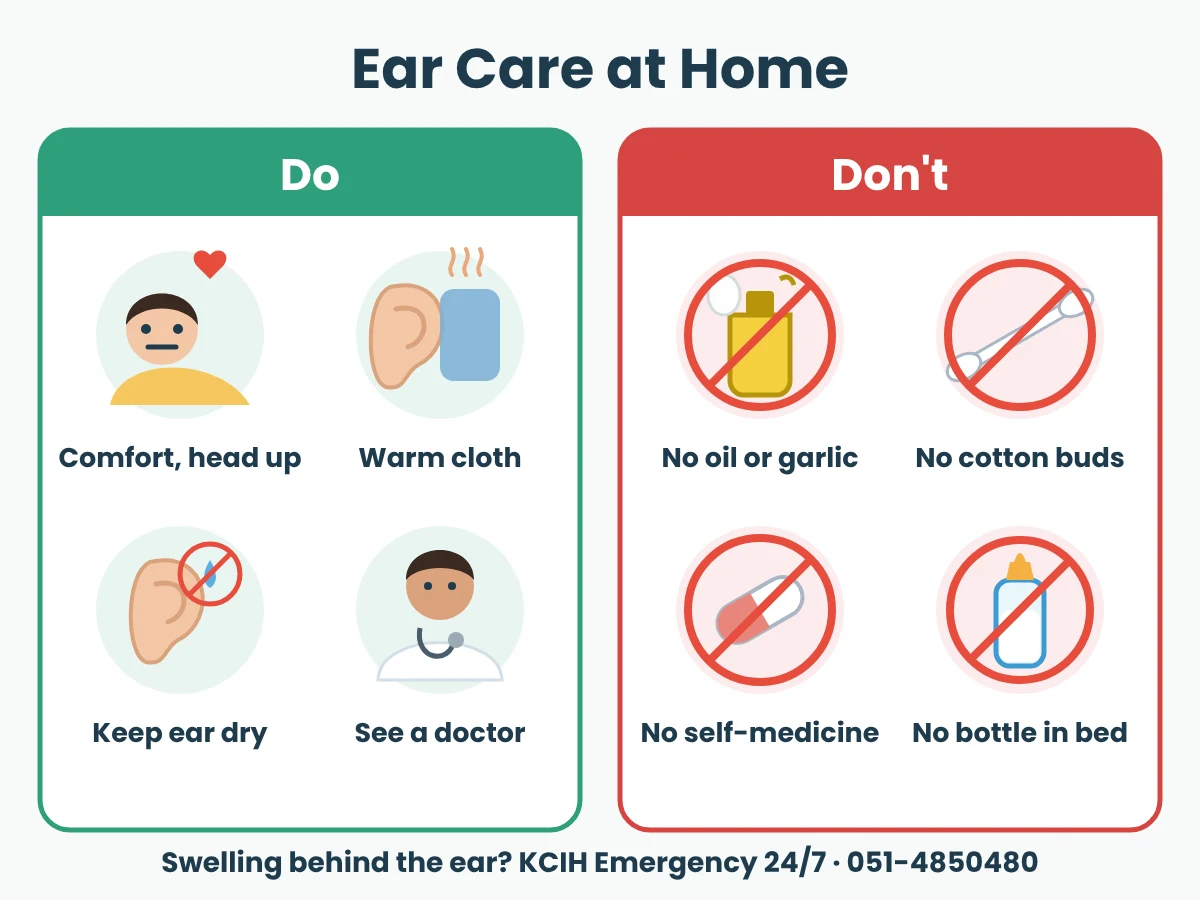
| Myth | Fact |
|---|---|
| “Warm mustard oil or garlic oil in the ear cures the pain.” | Oil doesn’t reach the middle ear, can hide the problem from the doctor, and can cause infection if the eardrum has a hole. |
| “Cleaning the ear with cotton buds prevents infection.” | Ear infections start behind the eardrum. Buds push wax deeper and can hurt the canal. |
| “Ear discharge is the dirt coming out, so it’s a good sign.” | Discharge usually means a hole in the eardrum or an infection. A doctor must check it. |
| “Every earache needs an antibiotic.” | Many get better on their own. The doctor decides based on age and severity. |
Some children get one ear infection after another, or fluid stays behind the eardrum for months. This can make sounds muffled, which matters because children learn to talk by hearing. Signs include turning up the TV, not responding when called, speaking unclearly or doing poorly at school.
Fluid after an ear infection usually clears within several weeks. If it stays for more than 3 months, or infections keep coming back, the doctor may refer your child to an ear specialist. Treatment options include:
Our child specialists in the Pediatric Medicine department check children’s ears every day and can advise whether treatment, follow-up or a hearing test is needed. For swelling behind the ear, a stiff neck or high fever, our children’s emergency is open 24/7 on Saidpur Road, Rawalpindi, about 20 minutes from Islamabad. Call 051-4850480 or 0339-4850480.
Most improve within 2 to 3 days and settle within a week. Fluid behind the eardrum can take several weeks to clear.
Yes, once the fever has gone and they feel well enough. Ear infections themselves don’t spread from child to child, though the cold that caused them can.
Normal bathing is fine. If the ear is discharging or the eardrum has burst, keep water out until a doctor says it has healed.
Hearing is usually only reduced for a short time while fluid is present. Repeated or long-lasting infections and chronic discharge can cause lasting damage, which is why follow-up and hearing checks matter.
Kaan mein tel ya koi cheez na daalein. Bachay ko aaram dein, sar thora ooncha rakhein, aur doctor ka bataya hua dard ka ilaaj dein. Agar kaan ke peeche soojan ho, kaan se peep ya khoon aaye, ya 2–3 din mein behtar na ho, to foran doctor ko dikhayein.
Learn more about our Child Health Conditions A–Z and our editorial process.