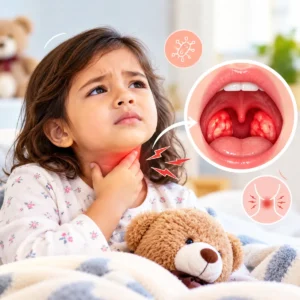
Quick answer: Most throat infections in children are caused by viruses and get better on their own within about a week with rest, fluids and comfort care. A smaller number are caused by bacteria called group A strep (“strep throat”). Strep needs a test and a full course of antibiotics prescribed by a doctor, because untreated strep can lead to rheumatic fever, which damages the heart. If your child cannot swallow their own saliva, is drooling, or is struggling to breathe, come to the emergency straight away.
A throat infection means the back of the throat (pharynx) or the tonsils are inflamed. Doctors call it pharyngitis when the throat is affected and tonsillitis when the tonsils are swollen and red. Parents in Pakistan often call it “gala kharab” or “gale mein infection”.
Viruses cause most of them: the same cold and flu viruses that cause a runny nose and cough. These spread easily at school and at home, especially in winter.

Group A strep bacteria cause a smaller share of throat infections, mostly in school-age children. Strep matters because, if it isn’t treated properly, it can trigger rheumatic fever, an illness that can permanently damage the heart valves.
Rheumatic heart disease is now rare in many rich countries, but it is still seen in Pakistan: a study of more than 15,000 school children in Islamabad found about 1.5 cases in every 1,000 children. This is why a strep throat in a Pakistani child should never be ignored.
Other things can make a throat sore without infection: dry air, smoke at home, dust and smog, and allergies with a blocked nose that make a child breathe through the mouth at night.
Common to most throat infections
Young children can’t always say “my throat hurts”. Watch for refusing food or milk, drooling more than usual, crying while feeding, rubbing the neck or ears, or being unusually cranky.
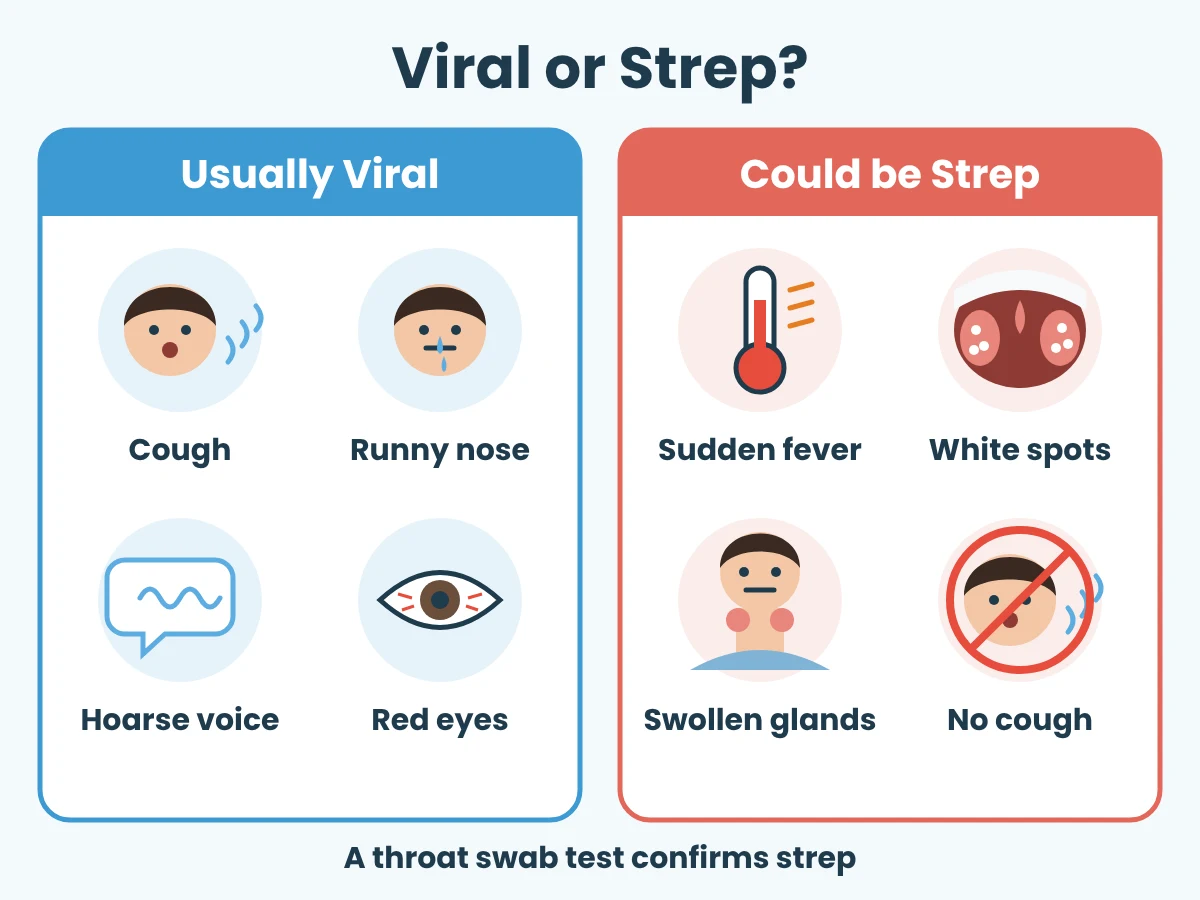
No single sign proves strep, but these clues help the doctor decide whether a test is needed.
| More likely viral | More likely strep |
|---|---|
| Cough, runny or blocked nose | Sudden sore throat with fever |
| Hoarse voice, red watery eyes | No cough or runny nose |
| Mouth ulcers or blisters | White patches or pus on the tonsils |
| Slow start with a cold | Swollen, tender neck glands |
| Any age, including toddlers | Child aged 5–15 |
| Headache, tummy pain or vomiting | |
| A fine, rough, sandpaper-like red rash (scarlet fever) |
If strep is possible, the doctor takes a throat swab: a quick, painless rub of the back of the throat with a cotton bud. It can be tested quickly or sent to the laboratory. A blood test isn’t needed for a simple sore throat.
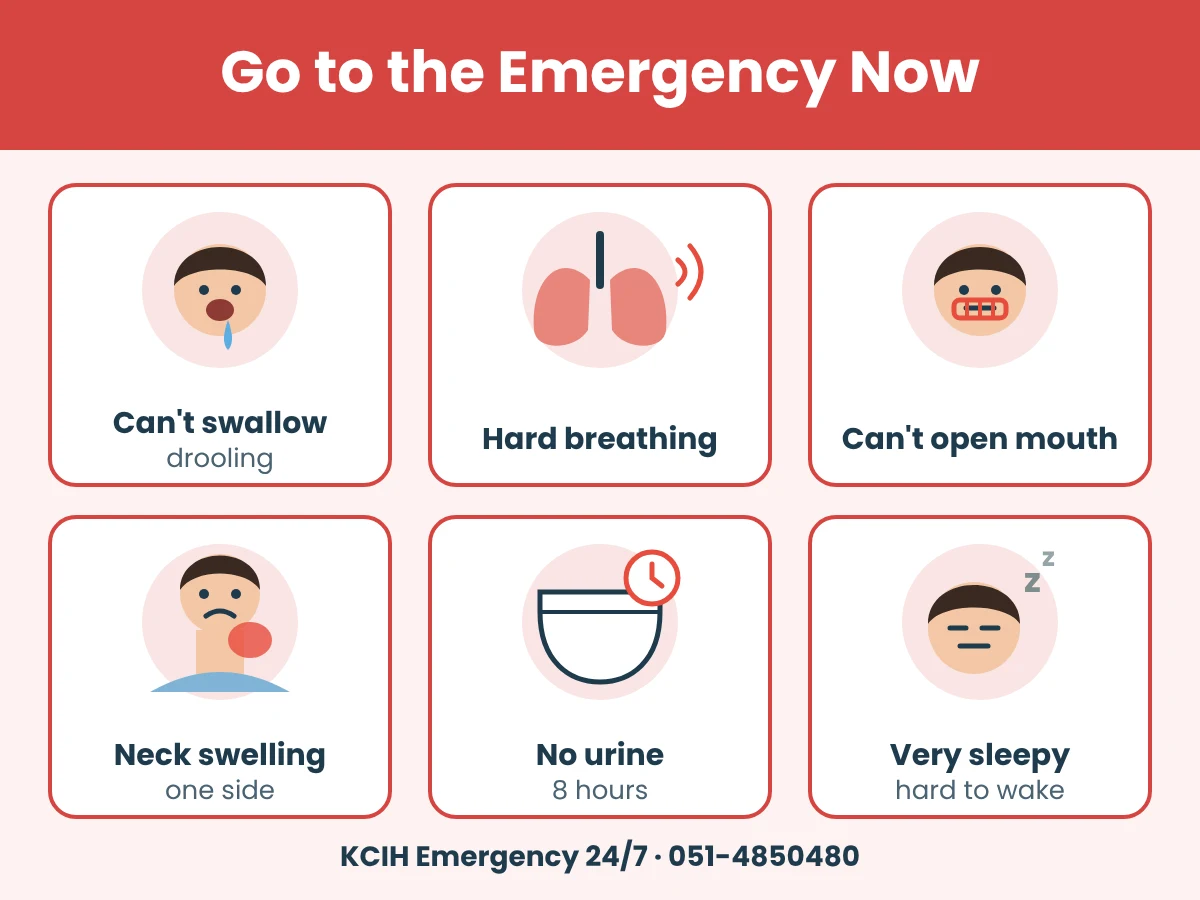
These can be signs of a throat abscess, a blocked airway or serious infection, all of which need urgent treatment.
See a doctor within a day or two if your child has a sore throat with fever and no cough, white patches on the tonsils, a sandpaper-like rash, or if the sore throat hasn’t improved after 5–7 days. Also see a doctor if your child has had several throat infections in a year.
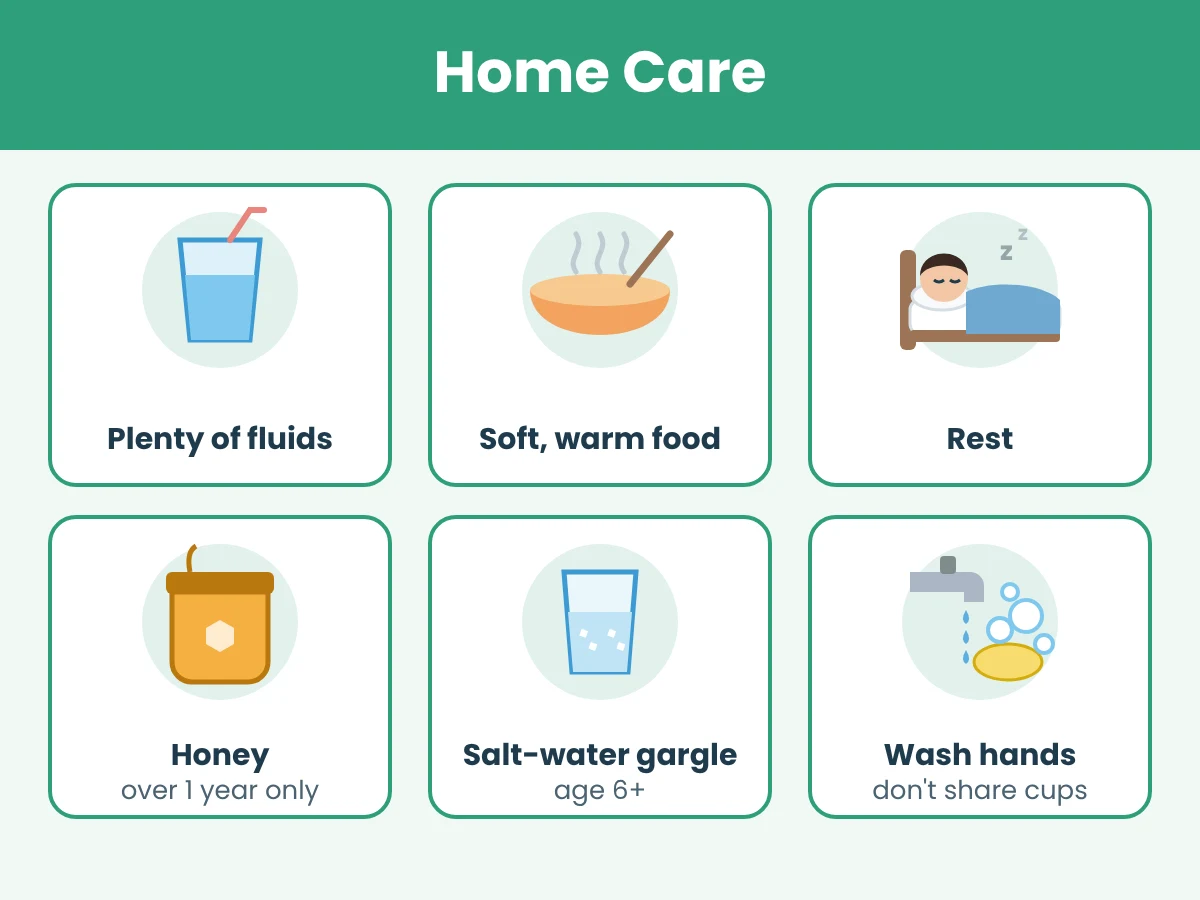
Viral throat infection: no antibiotics. The body clears the virus on its own, and treatment is about comfort: fluids, rest and pain relief your doctor advises.
Strep throat: your doctor will prescribe an antibiotic. The most important rule is to finish the whole course for as many days as the doctor prescribes, even if your child feels better after two or three days. Stopping early is the main reason strep comes back and the main way rheumatic fever is missed. Never use leftover antibiotics or ones prescribed for another child.
Pain and fever: give only the pain or fever medicine your doctor advises, in the dose for your child’s weight. Don’t give two medicines together unless the doctor says so. See our guide to fever in children for safe fever care.
Back to school: a child with strep can usually return once they have had antibiotics for at least 12 hours, the fever has gone and they feel well enough. With a viral sore throat, keep them home while they have a fever.

| Myth | Fact |
|---|---|
| “Cold drinks or ice cream cause throat infections.” | Infections are caused by germs, not cold food. Cool drinks can actually ease the pain. |
| “Every sore throat needs an antibiotic.” | Most are viral. Antibiotics only help strep, confirmed by a doctor. |
| “Once the fever goes, the antibiotic can stop.” | Stopping early can let strep return and leaves the risk of rheumatic fever. |
| “Painting the throat or pressing the tonsils helps.” | This can hurt and spread infection. It is not a treatment. |
| “Remove the tonsils after every infection.” | Surgery is only considered for frequent, severe infections (see below). |
Most throat infections get better without problems. Rarely, they lead to:
If you notice any of these signs after a throat infection, bring your child to a doctor.
Some children seem to get one sore throat after another. Removing the tonsils (tonsillectomy) is considered when infections are frequent and severe enough to disrupt the child’s life. A common guide is:
Large tonsils that cause loud snoring, pauses in breathing at night or poor sleep are another reason to see a specialist. Keep a simple diary of each episode (date, fever, school missed, any swab result) to help the doctor decide.
Our child specialists in the Pediatric Medicine department see children with throat infections every day and can check whether a swab test is needed. For breathing or swallowing problems, our children’s emergency is open 24/7 on Saidpur Road, Rawalpindi, about 20 minutes from Islamabad. Call 051-4850480 or 0339-4850480
Most get better within a week. With strep, the child usually feels better within two to three days of starting antibiotics, but the full course must still be finished.
Yes. Both viral and strep throat infections spread through coughs, sneezes and shared cups. Strep usually stops spreading about 12 hours after antibiotics start.
Strep is uncommon under 3 years. Sore throats in babies and toddlers are usually viral, but a baby under 3 months with any fever must see a doctor.
A fine, rough red rash with a sore throat can be scarlet fever, which is caused by strep. See a doctor for a test.
Agar bacha thook na nigal sake, saans lene mein mushkil ho, munh na khol sake, bukhar ke sath gale mein safaid daane hon, ya 5 se 7 din mein behtar na ho, to foran doctor ko dikhayein.
No. A child with a cough, runny nose and mild sore throat usually has a virus. The doctor will swab when the signs point towards strep.
Learn more about our Child Health Conditions A–Z and our editorial process.