- info@kcih.pk
- 051-4850480 | 0339-4850480
Typhoid in children starts with a fever that climbs higher every day and will not settle properly with paracetamol. The bacteria come from contaminated food or water. Your child needs a blood test and the right antibiotic. Untreated, it can tear the gut and kill.
This matters more here than in most countries. Pakistan has one of the highest childhood typhoid rates in the world, and drug-resistant typhoid is now spread across the country. Cases climb through summer and the monsoon.
So the familiar routine fails. A fever syrup, then an antibiotic from the pharmacy, then stopping it once the fever breaks. That is how children end up admitted with a hole in the intestine.
Typhoid fever is an infection caused by bacteria called Salmonella Typhi. Families here call it miyadi bukhar.
Your child swallows the bacteria in food or water. The bacteria cross the gut wall, reach the bloodstream, and travel around the body. This is why typhoid is not a simple loose-motions illness. It hits the whole child. That is why they look so flat and lie so still.
Paratyphoid is a close cousin. Usually milder. Treated the same way.
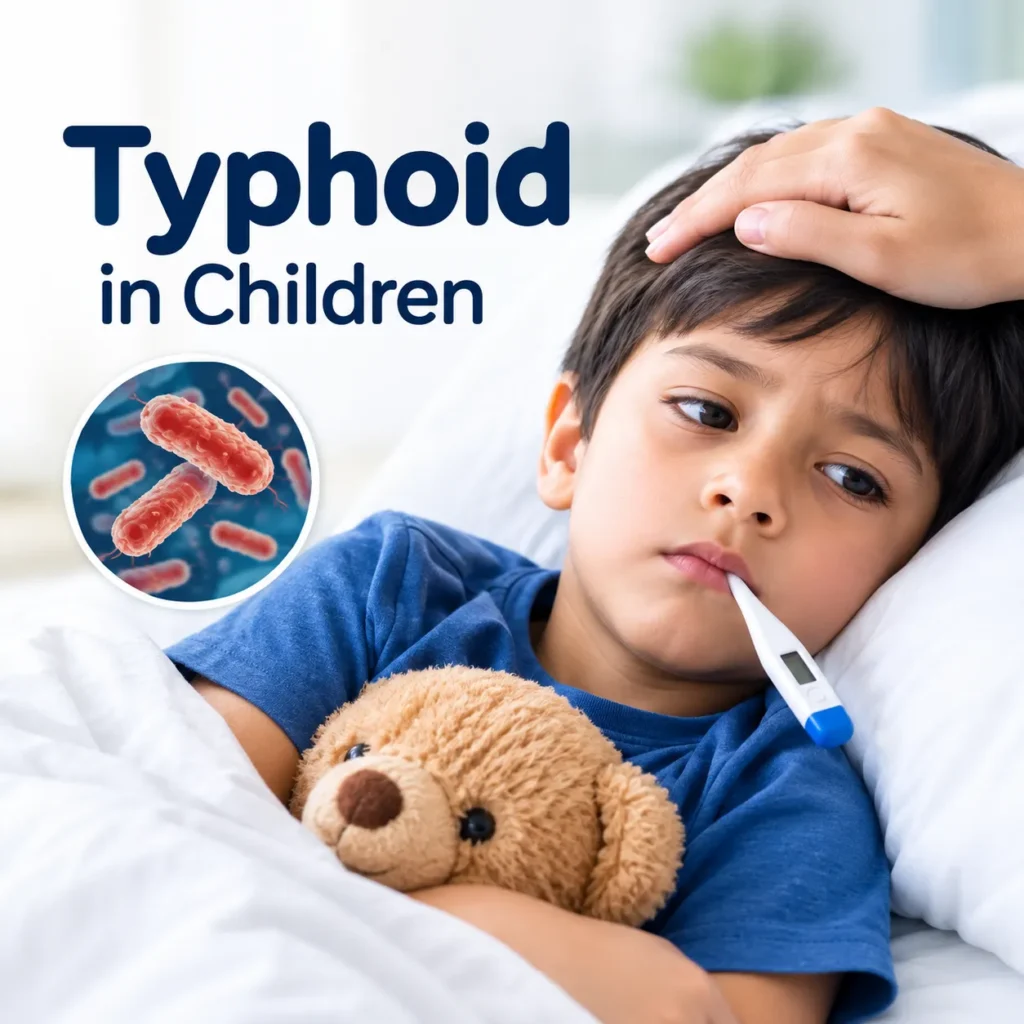
The bacteria live in the stool of an infected person. They reach your child’s mouth through food or water contaminated somewhere along the way.
In Pakistani homes, these are the usual routes:
One fact surprises most parents. Someone can carry these bacteria in their gallbladder for months after feeling completely well. They pass them on the whole time, with no symptoms at all. A cook, a helper, a family member. It is also why a recovered child needs a follow-up check before making food for anyone else.
Typhoid does not arrive suddenly. Symptoms start about one to three weeks after your child swallows the bacteria. Then the illness builds in a pattern.
The fever starts low and climbs. Each evening runs a little higher than the last, often touching 39 to 40 degrees by the end of the week. Paracetamol pulls it down partway. It rises again. It never fully clears.
Your child gets a headache, body aches, and no appetite. The tiredness is heavy. Some children have a dry cough, which sends families down the chest-infection path for a week or more.
Now your child looks properly ill. They lie quietly, refuse to play, and answer slowly. The tummy turns sore and bloated. Some children get diarrhoea. Some get constipation instead.
Faint pink spots can appear on the chest and tummy, each about the size of a pinhead. They are hard to see on brown skin, and plenty of Pakistani children never show them at all. If you cannot find a rash, that rules nothing out.
Confusion may start this week. Your child might not know where they are, or may stare and not answer.
This is when the serious complications happen in an untreated child. The gut wall can tear or bleed. Antibiotics given earlier prevent nearly all of it.
Children under five are different. Many have only a fever. No rash, no clear tummy pain, nothing to point at. That is exactly why diagnosis gets delayed in this age group. Any fever lasting more than three days in a young child needs a doctor, not another syrup.
A hard, swollen tummy with severe pain can mean the gut has torn. That needs surgery. Do not wait for morning.
See a child specialist this week if your child has had fever for more than three days with no clear cause. That is the window where treatment stays simple.
Almost every family reaches us holding a Widal report. Usually an antibiotic has already been started on the strength of it.
The Widal test is not reliable. It measures antibodies, not the bacteria themselves. It turns positive in children who had typhoid months ago, in children who got the vaccine, and in children who have something else entirely. It also reads negative in children who truly have typhoid. Guidance advises against using it to diagnose typhoid, because it is wrong so often.
So a positive Widal is not a diagnosis. A negative Widal does not clear your child either.
Blood culture is the real test. The lab grows a blood sample to see whether the bacteria are actually there. It takes two to three days. That wait feels unbearable while your child burns with fever, and it is still worth it.
The culture does two jobs. It confirms typhoid, and it shows which antibiotics still kill that particular strain. In Pakistan the second job has become the whole game.
Stool and urine cultures help in some cases. Your doctor may add a blood count, and an X-ray or ultrasound if the tummy is very painful or swollen.
One practical thing. Blood culture works best before antibiotics start. If you have already given something from the pharmacy, tell the doctor which medicine and how many days. It changes how they read the result.
In late 2016 an outbreak of extensively drug-resistant typhoid began in Sindh. It has since spread across the country, Punjab included. Doctors call it XDR typhoid.
These bacteria survive most antibiotics that used to work. That includes the common oral ones pharmacies hand out for fever, and the injections given in many small clinics. Children under five have been hit hardest.
Only a couple of treatments still work dependably, and some children need admission for intravenous antibiotics. Which one your child needs depends on the culture report. Guessing is no longer safe.
Two habits drive this resistance. Both are fixable at home.
Finish every dose your doctor prescribed, even after your child seems fine. This one habit protects your child and every child who drinks the same water.
Typhoid needs antibiotics. Nothing else clears it. No home remedy will.
Your doctor picks the antibiotic based on how ill your child is and, where available, on the culture report. Mild cases are treated at home with oral medicine. Children who are vomiting, very drowsy, badly dehydrated, or showing tummy complications get admitted for intravenous treatment and fluids.
Never use a leftover antibiotic from an earlier illness. Never repeat a cousin’s prescription. The strain differs, the weight-based dose differs, and the wrong choice just buys the bacteria time.
Watch for a relapse. Around one child in ten falls ill again, usually about a week after finishing the course. The second round is normally milder. Go straight back if the fever returns.
Pakistan was the first country in the world to add the typhoid conjugate vaccine to routine childhood immunisation. Your child gets it free at 9 months, at the same EPI visit as the measles vaccine.
One dose gives long-lasting protection. It does not make typhoid impossible. It does sharply cut the severe, hospital-level illness.
Missed it? Ask at your nearest EPI centre or at our clinic. Older children who were not covered by the earlier catch-up campaigns can still be vaccinated. Check your child’s vaccination card tonight and look at the 9-month row.
| What people believe | What is actually true |
|---|---|
| A positive Widal means my child has typhoid. | It does not. Widal stays positive after old infections and after vaccination, and it misses real cases. Blood culture answers the question. |
| Stop the antibiotic once the fever goes. | The fever settles days before the bacteria clear. Stopping early causes relapse and builds resistance. Finish the course. |
| An injection works faster, so ask the clinic for one. | Most children with typhoid can take oral medicine at home. Injections are for children who are vomiting or seriously ill. |
| Miyadi bukhar comes back every year, like a seasonal thing. | Typhoid is not something your child carries and re-develops. A repeat episode means repeat exposure, usually the drinking water, or an unfinished course the first time. |
| Only dirty homes get typhoid. | Contaminated municipal water infects children from spotless houses. Many parents blame themselves. This is not about your kitchen. |
| Stop food until the fever breaks. | Typhoid strips weight quickly. Soft food and fluids throughout help your child recover faster. |
Book this week if your child has had fever for more than three days with no obvious cause, or fever with tummy pain, or a fever that keeps climbing every evening.
Come to the emergency room today for severe tummy pain or a hard swollen tummy. Also for blood in the stool, confusion, a fit, or a child too weak to wake.
Our Pediatric Medicine department at Kids Care International Hospital in Rawalpindi handles typhoid end to end. Blood culture and lab work are done on site. Mild cases go home on oral medicine. Children who need admission get intravenous antibiotics and fluids, with surgical assessment if the gut is involved. You can check clinic timings for our child specialists and consultant pediatricians and book online.
Typhoid is one of three infections behind most long fevers in Pakistani children. Malaria and dengue are the others, and each needs a different test.
With the right antibiotic, the fever usually starts settling within two to three days and your child feels much better inside a week. Full energy takes a little longer. Untreated, typhoid fever can run for three weeks or more, and that is when complications appear.
Give soft, easy food and plenty of fluids, and do not stop feeding your child. Khichri, rice, dahi, banana, boiled potato, dal, soup and lassi all work well. Offer small amounts often rather than large meals, because appetite drops sharply. Leave out heavy, oily and very spicy food while the tummy is sore. Typhoid strips weight quickly, so restricting food to “rest the stomach” slows recovery down.
Two things separate them. A viral fever spikes then drops properly, while a typhoid fever climbs a little higher each evening and never fully clears. And your child’s behaviour differs: with a viral fever children start playing again once the temperature falls, but a child with typhoid stays flat and uninterested even when the fever eases. Any fever past three days needs a doctor either way.
On its own, very little. The Widal test measures antibodies, not the bacteria, so it stays positive months after an old infection and after the typhoid vaccine. It also reads negative in children who genuinely have typhoid. A child with no symptoms does not need antibiotics because of a Widal report. Ask your doctor to review it against a blood culture.
Usually two to three days. The lab needs time to grow the bacteria from your child’s blood sample. That wait is hard when your child is burning with fever, and it is worth it, because the culture shows which antibiotics still work against that particular strain. Your doctor may start treatment before the report arrives and adjust it once the result is in.
It does not spread by coughing or playing together. It spreads when stool reaches the mouth, almost always through contaminated food or water. A child stays able to pass it on for a few weeks after recovery, and a small number of people carry the bacteria in the gallbladder for a year or longer with no symptoms. That is why a recovered child needs a follow-up check before preparing food for anyone else.
Yes. About one child in ten relapses, usually around a week after finishing the antibiotic course, and the second illness is normally milder. Stopping the course early makes a relapse far more likely. A fever returning weeks or months later may instead be a fresh infection from the same water source. Either way, take your child back and tell the doctor which antibiotic was used and whether the full course was completed.
Yes, it is free. The typhoid conjugate vaccine is part of Pakistan’s routine EPI schedule and is given at 9 months of age, at the same visit as the measles vaccine. Pakistan was the first country in the world to add it to routine immunisation. One dose gives long-lasting protection, though no vaccine makes typhoid impossible, so keep the water and food precautions going. If your child missed it, ask at your nearest EPI centre about catch-up vaccination.