- info@kcih.pk
- 051-4850480 | 0339-4850480
Quick answer: A newborn checkup is a routine visit where a child specialist checks your baby’s weight, feeding, breathing, heart, skin colour, cord and reflexes, and answers your questions. The World Health Organization (WHO) advises checks within 24 hours of birth, on day 3, between days 7 and 14, and at 6 weeks. These visits catch problems like jaundice, feeding trouble or infection early, often before parents notice anything. If your newborn stops feeding, has a fit, breathes very fast, feels hot or cold, or turns yellow in the first day, don’t wait for the checkup. Bring the baby to a doctor straight away.
A newborn checkup, also called a well-baby visit, is a visit when your baby is not sick. Its purpose is to make sure your baby is growing, feeding and developing well, and to find any problem early, while it is easiest to treat.
The first check usually happens before you leave the hospital. The next ones happen in the first two weeks, which is when most newborn problems, such as jaundice, poor feeding and weight loss, show up. Many parents in Pakistan skip these visits if the baby “looks fine”. But some serious problems, like a heart murmur, a hip that slips out of place or a slowly rising yellow colour, can’t be seen at home.
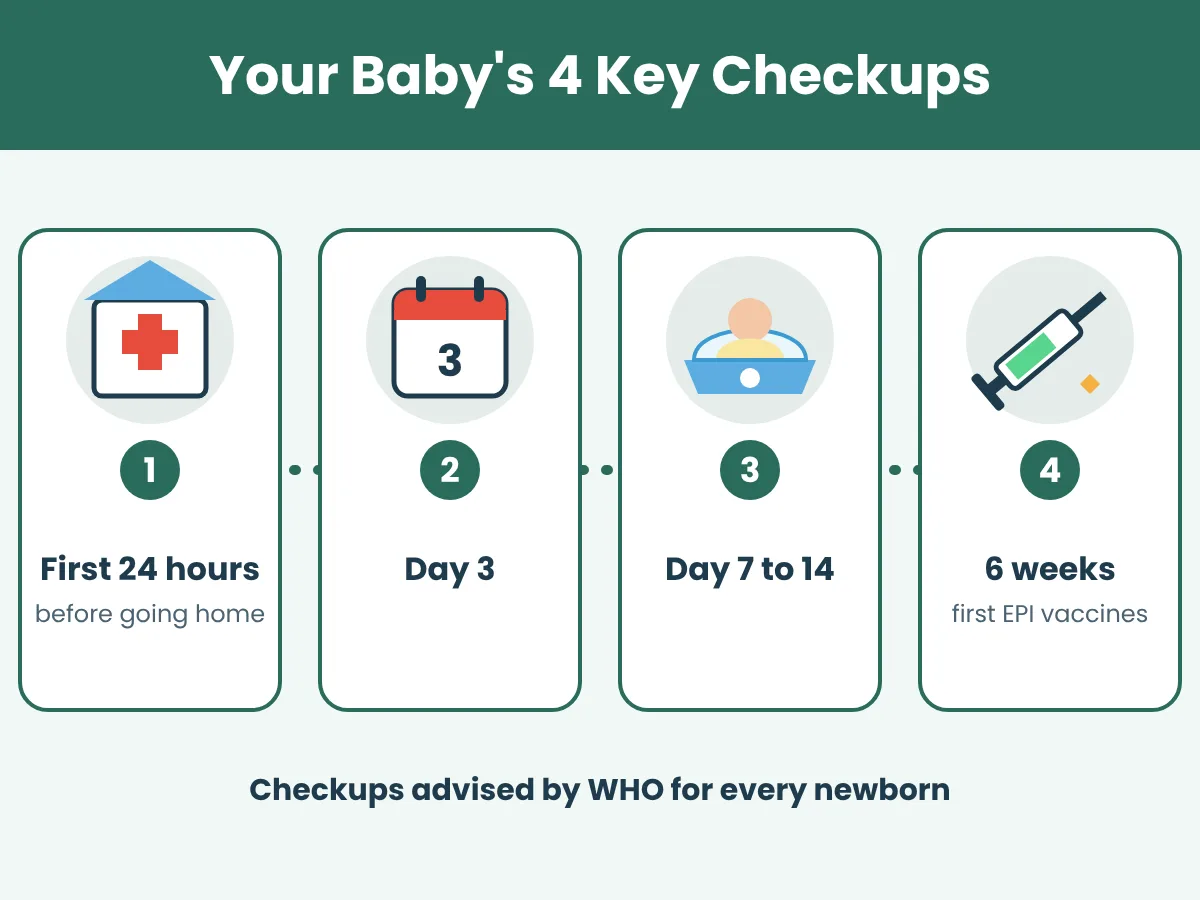
| Visit | Age | Main focus |
|---|---|---|
| First check | Within 24 hours of birth, before going home | Full head-to-toe exam, first feed, birth vaccines |
| Second check | Day 3 (48 to 72 hours) | Jaundice, feeding, weight loss, cord |
| Third check | Days 7 to 14 | Weight gain, feeding, jaundice settling |
| Fourth check | 6 weeks | Growth, development, first EPI vaccines |
| Then | With each EPI vaccine visit: 10 weeks, 14 weeks, 9 months and 15 months | Growth, milestones, vaccines |
If your baby was born early, small, by a difficult delivery, or went home within 24 hours, the doctor may want to see them sooner.
Your baby will be weighed without clothes, and their length and head size measured. These numbers are plotted on a growth chart. The doctor looks less at one number and more at the line your baby follows over time.
It is normal for a newborn to lose a little weight in the first few days. Most babies then start gaining again, and your doctor will tell you when your baby should be back to birth weight. If the weight keeps dropping, or comes back slowly, it usually means feeding needs some help.
Expect questions about how often your baby feeds, how long, and how it feels for you. Newborns feed often, day and night, because their stomachs are small. The doctor may watch a feed to check the latch. Tell them about sore nipples, a baby who falls asleep at the breast, or worries that your milk isn’t enough. These are common and fixable.
Counting nappies is one of the best ways to know your baby is getting enough milk.
Watch for these signs:
Fewer wet nappies, dark urine or no stool are signs to call the doctor.
The doctor will gently check:
Yellow skin is common in the first week and usually harmless. But high levels can harm the brain, so the doctor checks the skin and eyes, and may do a quick skin or blood test. Read more in our guide to jaundice in newborn babies.
Ask whether your baby has had these. Not every hospital in Pakistan does them routinely:
Under Pakistan’s free Expanded Programme on Immunization (EPI), your baby gets BCG (against TB) and the first polio drops at birth, and in many areas a hepatitis B birth dose. The next vaccines are due at 6, 10 and 14 weeks: pentavalent, polio, pneumococcal (PCV) and rotavirus (6 and 10 weeks only), with the injected polio vaccine (IPV) at 14 weeks. Measles-rubella and the typhoid vaccine follow at 9 months, and a second measles-rubella dose at 15 months. Bring your baby’s vaccination card to every visit.
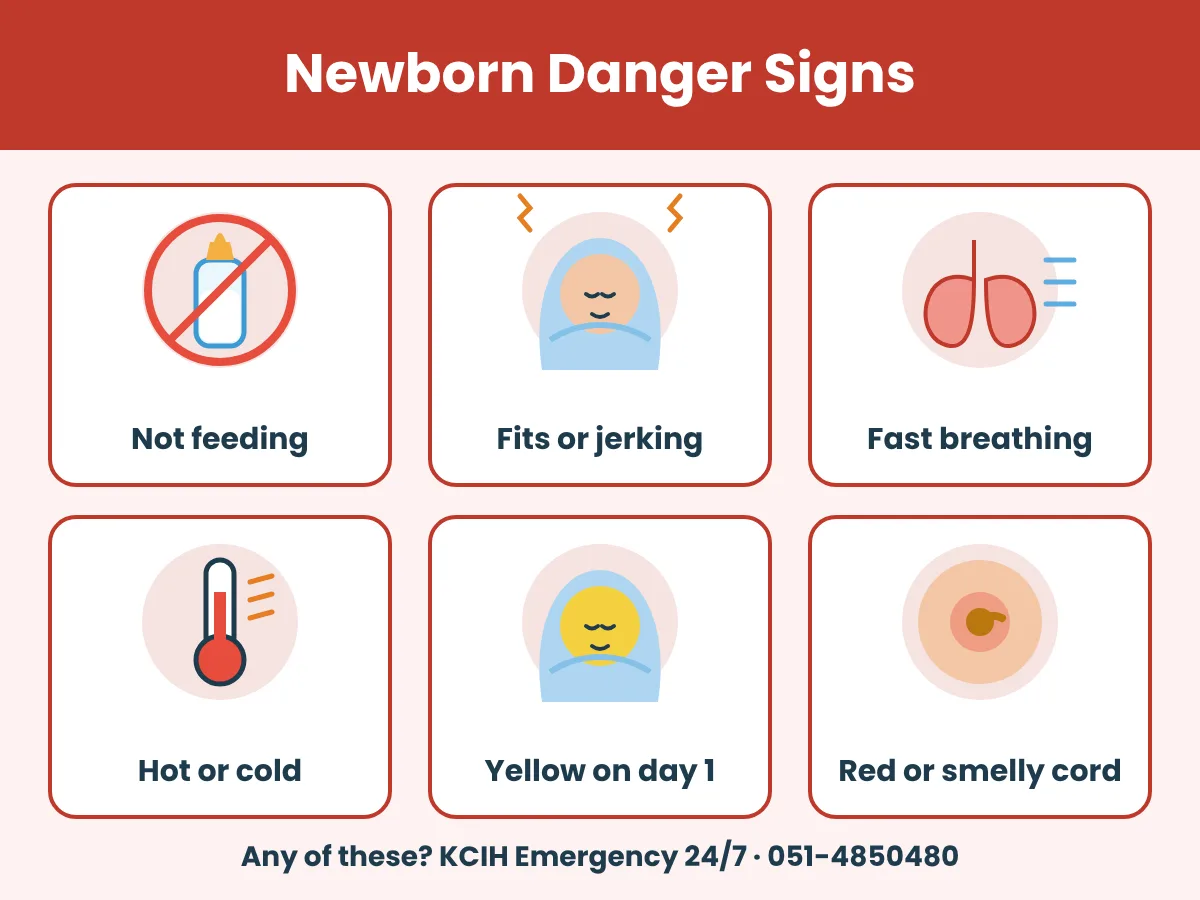
These are the warning signs listed by WHO. In newborns, infections can get worse within hours, so it is always better to come and be told everything is fine.
| Myth | Fact |
|---|---|
| “Babies need water in summer.” | Breast milk is mostly water. Babies under 6 months need no extra water, even in the heat. |
| “Put surma or kajal in the eyes to make them big and bright.” | Surma can contain lead and can cause eye infections. Nothing should go in a baby’s eyes. |
| “Apply ghee, oil or ash to the cord so it heals fast.” | Keep the cord clean and dry. Things put on it can cause dangerous infection. |
| “Wrap the baby tightly to keep the legs straight.” | Tight wrapping of the legs can harm the hips. Leave room for the legs to bend. |
| “Massage with oil and press the head into shape.” | Gentle massage is fine, but never press the soft spots. |
Bring with you:
Questions you might ask:
Look after yourself, too. Feeling tired and tearful after birth is common. If sadness, worry or trouble sleeping doesn’t go away, or gets worse, tell the doctor. Help is available.
Our child specialists in the Pediatric Medicine department see newborns for routine checkups, feeding support, jaundice checks and vaccines. Babies who need extra care are looked after in our neonatal unit. Read what a NICU is and what to expect. For any danger sign, our children’s emergency is open 24/7 on Saidpur Road, Rawalpindi, about 20 minutes from Islamabad. Call 051-4850480 or 0339-4850480.
This guide is for information and does not replace a doctor’s examination.
WHO advises a check on day 3. If you left hospital early, the baby was born early or small, or there are feeding worries, the doctor may want to see your baby sooner.
Most babies lose a little weight in the first few days and then start gaining again. Your doctor weighs your baby at each checkup and will tell you if the weight loss is more than expected.
Yes. A short, direct trip to the clinic is safe. Keep the baby warm but not overwrapped, and avoid crowded places on the way.
Yes. Checkups catch problems like rising jaundice, a heart murmur or hip trouble that parents can’t see at home.
Pehla checkup hospital se chuti se pehle hota hai. Phir teesray din, 7 se 14 din ke darmiyan, aur 6 hafte par doctor ko dikhayein. Agar bacha doodh na piye, bukhar ho, saans tez chale ya pehle din peela ho jaye, to checkup ka intezar na karein, foran doctor ke paas le kar jayein.
Learn more about our Child Health Conditions A–Z and our editorial process.