- info@kcih.pk
- 051-4850480 | 0339-4850480
Seeing your newborn turn yellow is frightening, especially in the first few days when everything else is already new. Here is the reassuring part: jaundice is one of the most common things that happens to newborn babies, and in most cases it clears on its own without any treatment at all.
But it is not something to simply wait out either. A small number of babies develop bilirubin levels high enough to harm the brain, and that damage is permanent once it happens. The entire purpose of good newborn care is to find those few babies early, while treatment is still simple and completely effective.
This guide from the Pediatric Medicine and Neonatology team at Kids Care International Hospital explains what jaundice is, how to check your baby at home, and exactly which signs mean you should not wait until morning.
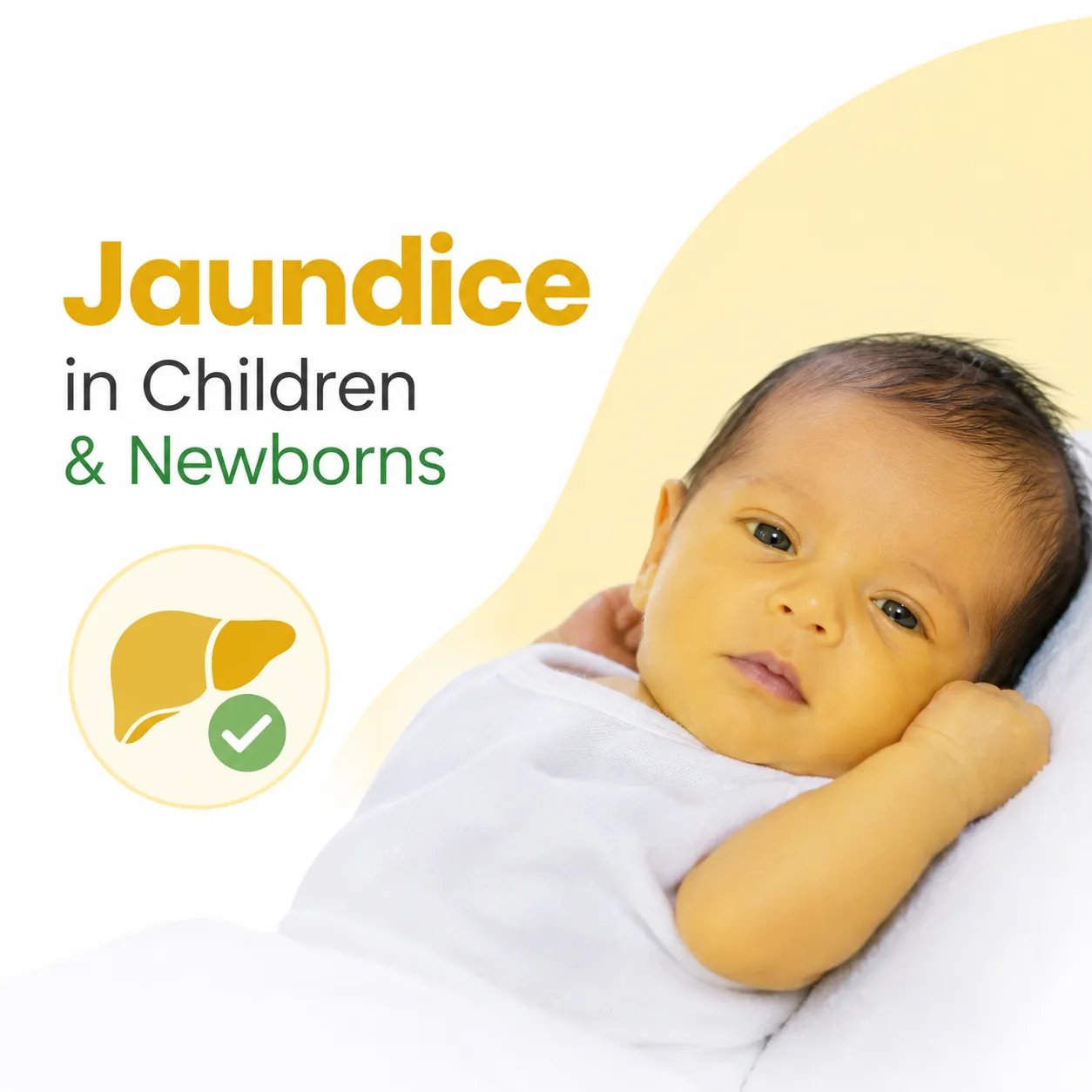
Jaundice is the yellow colour that appears in a baby’s skin and in the whites of the eyes. It happens when a yellow substance called bilirubin builds up in the blood.
Bilirubin is made naturally when old red blood cells break down. Before birth, your liver cleared it for your baby. After delivery, the baby’s own liver has to take over that job — and a newborn liver is simply slow to start. At the same time, newborns have more red blood cells breaking down than adults do. More bilirubin being produced, and a liver not yet working at full speed, is exactly why so many babies turn a little yellow in their first week.
This is common, not rare. Roughly 6 in 10 full-term babies and around 8 in 10 premature babies develop some degree of jaundice during their first week of life.
Several conditions make red blood cells break down faster than a newborn liver can cope with. These matter a great deal in Pakistan:
Check in bright natural daylight near a window, not under a yellow tube light, which distorts the colour.
Press gently on your baby’s forehead, nose or chest with one finger, then lift it away. In the moment the skin blanches, look at the colour underneath. If it looks yellow rather than pale, jaundice is present.
If your baby has a darker skin tone, the yellow tint is harder to see on the skin. Look instead at the whites of the eyes, the gums and under the tongue, and press on the palms and soles — these are more reliable.
Jaundice starts at the head and spreads downwards as bilirubin rises. Yellow only on the face is usually mild. Yellow that has reached the tummy, arms and legs means the level is higher, and the baby should be seen by a doctor.
Sleepiness, poor feeding, a high-pitched cry and arching are the warning signs of bilirubin affecting the brain. This is an emergency.
The doctor will first estimate the level using a small handheld device pressed against the baby’s skin or forehead. This is painless and takes seconds. If the reading is high, a blood test follows — usually a small prick on the heel — to measure the exact bilirubin level.
Parents often ask which number is dangerous. There is no single number that applies to every baby, and any chart offering one is out of date. The safe level depends on three things together: how many hours old the baby is, how many weeks of pregnancy they were born at, and whether they have risk factors such as G6PD deficiency or infection. A level that is perfectly acceptable in a healthy five-day-old can be dangerous in a baby only eighteen hours old — which is why the number must be interpreted by a doctor, not compared against something found online.
If the jaundice is early, severe or prolonged, further tests find the cause: blood groups of mother and baby, a Coombs test, full blood count, G6PD level, thyroid tests, tests for infection, and — if the stools are pale — tests of the liver and bile ducts.
Feeding — the foundation
Bilirubin leaves the body in stool. A baby who feeds well passes more stool and clears bilirubin faster. Breastfeed 8 to 12 times in 24 hours, and wake your baby for feeds if they are sleepy. A jaundiced baby is often too drowsy to demand food, which quietly makes the problem worse.
Do not give water, glucose water, ghutti or any home preparation. Current guidelines advise against this clearly. These do not lower bilirubin, they fill a newborn’s small stomach so less milk is taken, and they can cause dangerous salt imbalances.
Phototherapy
This is the main treatment. The baby is placed under special blue lights wearing only a nappy, with soft pads protecting the eyes. The light changes bilirubin in the skin into a form the body can pass out easily, without the liver having to process it first.
Phototherapy is safe, painless and very effective. It is not the same as sunlight and does not burn the baby. Most need it for about one to two days, and breastfeeding continues during treatment, with short breaks for feeding and holding your baby.
Exchange transfusion
Rarely, when bilirubin is very high or rising fast despite phototherapy, the baby’s blood is replaced with donated blood in small amounts. This is done in a neonatal unit and works quickly. It is uncommon — but it is exactly the situation created by arriving late, which is why early checking matters so much.
| What people commonly believe | What is actually true |
|---|---|
| Put the baby in the sun (dhoop) to cure jaundice. | Not a recommended treatment. It cannot reliably bring down a high level, an undressed newborn risks sunburn, overheating or dangerous cold, and it wastes the days when real treatment would have worked. |
| Stop breastfeeding until the yellow goes. | Breastfeeding should increase, not stop. Less milk means fewer stools, and bilirubin then stays in the body longer. |
| Give glucose water or ghutti to flush it out. | These do not lower bilirubin and they reduce milk intake. Guidelines advise against them. |
| All jaundice is normal, every baby gets it. | Most is normal. But jaundice in the first 24 hours, lasting beyond 14 days, or with sleepiness and poor feeding is not — and those are the babies at risk. |
| Phototherapy lights are harmful. | Phototherapy is safe and long established, and the eyes are covered as a precaution. The real harm comes from untreated high bilirubin. |
| Slight yellow needs no check. | Colour alone is unreliable, especially with darker skin. A quick painless check is the only accurate way to know. |
Most jaundice cannot be prevented, but severe jaundice usually can be. Three things do most of the work:
If you are Rh negative, make sure the anti-D injection is given as advised during pregnancy and after delivery. If G6PD deficiency runs in your family, tell the doctor before your baby is discharged.
If your baby looks yellow and you are unsure, have them checked. It takes a few minutes and settles the question properly.
The Pediatric Medicine and Neonatology team at Kids Care International Hospital, Rawalpindi, manages newborn jaundice at every level — bilirubin testing, phototherapy, investigation of the underlying cause, and exchange transfusion in our neonatal intensive care unit when it is needed. As a dedicated children’s and maternity hospital, we care for mother and baby together, with 24-hour pediatric emergency cover.
You can view our child specialists and consultant pediatricians and book an appointment online, or come to the emergency department at any hour if your baby shows any of the danger signs above.
Usually yes. More than half of newborns develop visible jaundice, most commonly appearing on day two or three, peaking around day three to five, and fading over the following week. It happens because a newborn’s liver is still maturing. Jaundice in the first 24 hours of life, or still present beyond two weeks, is not in this category and needs assessment
Immediately if the yellowing appears in the first 24 hours, if the stools are pale or chalky, if your baby is difficult to wake, floppy, feeding poorly, has a fever, or is passing very little urine. Also have your baby checked if jaundice is deepening rather than fading, reaches the palms and soles, or is still present at two weeks of age.
Because bilirubin leaves the body in bile, and bile is what gives stool its yellow or brown colour. Yellow stool means bile is draining normally. Pale, chalky or white stool means it is not — which can indicate a blockage of the bile ducts. That condition is treatable with surgery but results depend on operating early, so pale stools need same-day assessment at any age.
No, and it is not a safe substitute for proper treatment. Sunlight is far weaker than medical phototherapy and exposes a newborn to sunburn and dangerous overheating. Its biggest risk is false reassurance — parents feel the jaundice is being treated while the bilirubin level continues to rise. If your baby needs treatment, they need a measured level and phototherapy.
Almost never. In most cases the problem is too little milk rather than the milk itself, so the answer is more frequent, more effective feeding, often with lactation support. Breast-milk jaundice — mild yellowing lasting weeks in a thriving baby — is harmless and is not a reason to stop. Only change feeding on a doctor’s advice after assessment.
No. The baby lies under blue lights wearing a nappy, with the eyes covered. It does not hurt, does not burn the skin, and usually finishes within one to two days.
Ordinary newborn jaundice usually fades within one to two weeks, and a little longer in premature babies. Breast-milk jaundice in a well, thriving baby can persist for several weeks and is harmless once serious causes have been excluded. Jaundice that is deepening rather than fading, or still present at two weeks, needs review regardless of how well your baby seems.
At Kids Care International Hospital (KCIH) Rawalpindi, jaundiced babies and children are assessed by the child specialist Dr. Samer Sikander, with bilirubin testing and laboratory investigations at our on-site diagnostic facility, phototherapy, and NICU care for newborns who need closer support. Families attend from across Rawalpindi, Islamabad and the surrounding districts.
Learn more about our Child Health Conditions A–Z and our editorial process.